A locksmith website has one job above the rest: convince someone standing outside their own front door, on a phone, in the rain, that you are a real local locksmith and not a call centre that will sell the job on. That means a visible address or base town, a real name, a phone number they can tap without scrolling, honest coverage areas with rough response times, and prices that are at least explained. Everything else is secondary.
Why locksmith searches are different from most trades
Most trade enquiries can wait. Someone looking for a kitchen fitter will browse four or five sites over a weekend. Someone locked out at eleven at night will look at two, maybe three, and will ring whichever one looks real and answers.
The sector also has a reputation problem that is not your fault. Plenty of the results for "emergency locksmith" plus a town name belong to national booking operations that take the call, quote a low call out fee, then pass the job to whoever is nearest and available. Customers have heard the stories about the bill at the end. By the time they reach your site, some of them are already suspicious.
So your website is not really competing on design. It is competing on believability. Everything below is about making it obvious, in seconds, that there is an actual person with an actual van behind the page.
How do you prove you are a real local locksmith?
You prove it with specifics that a national operation cannot copy convincingly. Vague claims like "fast, friendly, local service" appear on every site in the sector, including the ones that are not local at all.
Put a place on the page, not just a county
"Covering the Midlands" tells a worried customer nothing. "Based in Grantham, out to Sleaford and Bourne" tells them whether you are twenty minutes away or ninety. If you work from home and do not want your street address public, use the town and a postcode district. That is normal and nobody minds.
Show the van, the workshop and the actual work
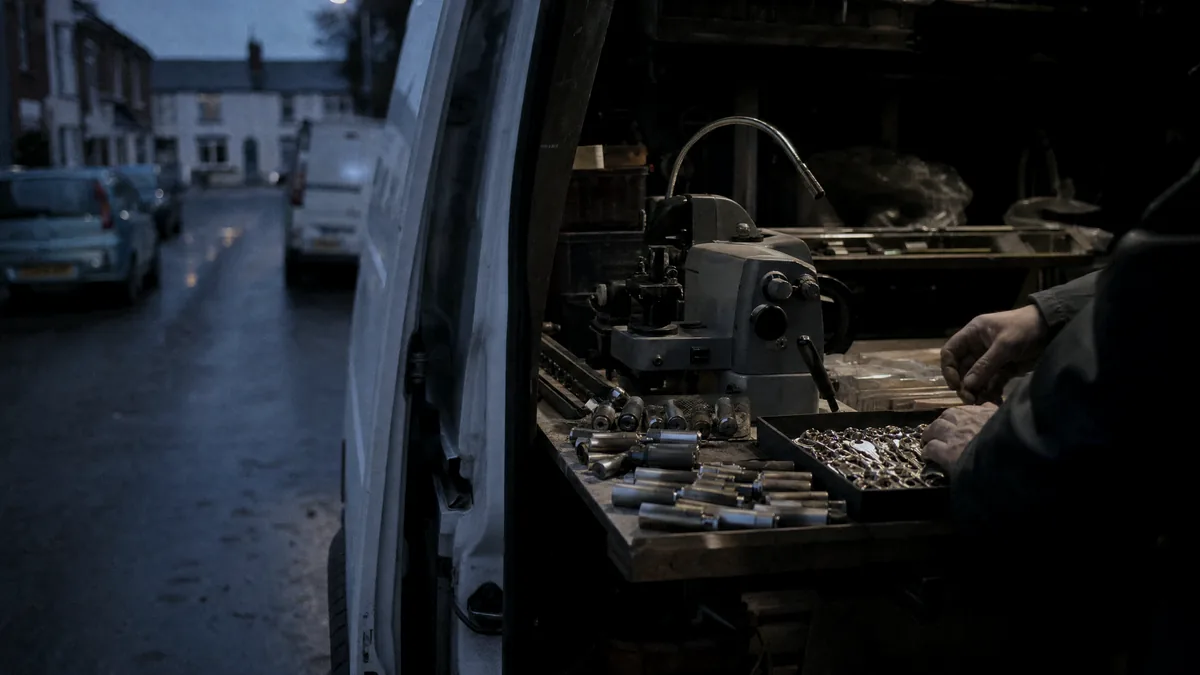
Photographs of your own van, your key cutting machine, a drilled euro cylinder on the bench, a new multipoint mechanism fitted into a uPVC door. Stock photos of a smiling man in overalls holding a giant key are instantly recognisable as stock. Phone photos of your own work beat them every time, even when the lighting is bad. Our packages include AI image creation if you have nothing at all, but for a locksmith your own photos are worth more.
Name yourself
An about page with your first name, how long you have been doing it, what you did before, and who turns up at the door. People are about to let a stranger into their house at midnight. Knowing it will be Dave, who has been doing this since 2014, is worth more than any badge. It is the same reason we put who you would be dealing with on our own site.
Make your credentials checkable
If you hold DBS clearance, are a member of a locksmith association, are insured to a stated level or are on an approved contractor list for a local authority or letting agency, say so plainly and say what it means. Logos alone get ignored. A sentence that explains the check behind the logo does not.
Showing your response areas honestly
The temptation is to list fifty towns on the off chance. Resist it. If someone in a town forty miles away rings and you take ninety minutes to get there, you have an angry customer and a bad review, and you have spent an evening badly.
A service area map is included on every one of our tiers, and for a locksmith it earns its keep. The useful version does three things:
- Shows a core area where you are genuinely quick, with a realistic time range rather than a promise. "Usually within 30 to 45 minutes" is honest. "20 minute response guaranteed" is a hostage to the A1.
- Shows an outer area you will travel to, with a note that it takes longer or carries a travel charge.
- Names the towns and villages in plain text as well as drawing them on a map, because the text is what a search engine can read.
Separate pages for your two or three biggest towns are worth having, provided each one says something different: where you park, which estates have the common door types, which letting agents you work with, how long it realistically takes you to get there. Twelve near identical pages with the town name swapped out are a waste of money and tend to do nothing. There is more on this in our piece on getting found on Google when you only work locally.
Handling emergency calls from a phone
Assume the person reading is holding a phone in one hand, outside, in poor light, possibly with a child or a dog with them. Design for that and the desktop version will look after itself.
The practical bits that matter:
- A floating call bar that stays on screen as they scroll, so the number is always one tap away. It is included on every RentAWeb site and on a locksmith site it is probably the single most used element on the page.
- The number as a tappable link, not an image and not text they have to copy out.
- Hours stated honestly. If you answer the phone until midnight and then stop, say so. "24/7" when you are actually asleep at 2am loses you a review you did not even earn.
- A fast loading page. Someone on a weak signal in a stairwell will not wait eight seconds. Heavy sliders and huge unoptimised photos are what usually cause it, and a slow website costs you work more in this trade than most.
- A short form as backup, not as the main route. Name, number, postcode, what has happened. Four fields. Nobody fills in a twelve field form while locked out.
- What happens next, in one line. "Ring and I will tell you roughly when I can be there and what it is likely to cost." That sentence does a lot of work.
Being straight about prices
You cannot quote a fixed figure for a job you have not seen, and nobody expects you to. You can still be far more open than the sector norm, which is itself a differentiator.
A pricing section that says your call out charge, your typical range for a standard uPVC lockout, what a euro cylinder replacement usually runs to, whether evenings and bank holidays cost more, and that you confirm the price before you start, puts you ahead of every site that just says "competitive rates". Customers who have been stung before are specifically looking for that page.
If you also do non-emergency work, and most locksmiths do, give it room. Lock upgrades after a burglary, insurance compliant locks for a policy renewal, key cutting, safes, access control for a small office, landlord and letting agent work, snapped key extraction. That work is better paid, better planned and not dependent on being first to answer the phone. Writing those words yourself is usually quicker than you think, and writing the words for your own website covers how to approach it.
The pages a locksmith site actually needs
Most locksmiths are well served by somewhere between five and ten pages. More than that and you are usually padding.
- Home, with the number, base town, coverage and hours above the fold
- Emergency lockouts, the page most people land on
- Lock repairs and replacements, including uPVC and composite doors
- Security upgrades and insurance compliant locks
- Commercial, landlord and letting agent work
- Areas covered, with the map and the town list
- Prices, or at least how your pricing works
- About, with your name, photo and background
- Reviews
- Contact
That lands comfortably in a ten page site. If you want individual town pages on top, extra pages are £10 a month each, or five for £40 a month, all plus VAT. The general shape of what a trade site needs is covered further in website design for tradesmen.
What locksmith website design should cost
You are not buying anything exotic. There is no booking system to integrate, no stock to manage, no payment gateway. A locksmith site is a small, fast, credible site with a phone number, and it should be priced like one.
Our Starter package covers up to 5 pages at £49 a month plus VAT, and Essential covers up to 10 pages at £79 a month plus VAT. Both include hosting, SSL, business email, the service area map, the floating call bar, an image gallery, an FAQ section, customer reviews, the Nova editor so you can change your own prices and photos, and a free redesign every year. A blog is included from Essential upwards, and is an option at £10 a month on Starter. A .co.uk domain is free with a package.
You pay the first three months up front to start, then monthly from month four. There is no setup fee and no contract, so you can cancel in any month with a month's notice. If you would rather own it outright, that is a separate one off price list: Starter with up to 5 pages is £1,188 and Essential with up to 10 pages is £1,788, with hosting, support and the editor at £250 a year or £30 a month after that. You can buy at the start or later, and the price is the same either way. Should you own your website or rent it? goes through which suits who.
The quickest way to see your own number is to price up your website with the pages and options you actually want.
Frequently asked questions
Should I list every town I will travel to?
List the ones you can reach in a sensible time and be honest about the rest. A short, accurate coverage list with rough response times does more for you than a long one that generates calls you cannot serve. You can always add an outer zone with a travel charge noted.
Do I need a 24 hour phone number on the site?
Only if you genuinely answer it. Plenty of locksmiths do well stating real hours, for example 7am to 11pm seven days. Claiming 24/7 and missing calls at 3am costs you reviews. State what you actually do and the people who ring you will be the right ones.
Can I put my own photos on instead of stock images?
Yes, and for a locksmith you should. Photos of your van, your bench and your finished work are more convincing than anything generic. AI image creation is included free on every tier if you are short, and you can mix your own photos with generated ones however you like.
How quickly can I change my call out price on the site?
You can do it yourself in the Nova editor in a couple of minutes, or send it to us and we will change it. Content changes like words, prices and photos are unlimited and free on every package, so there is no reason to leave an out of date price sitting there.
The short version
Locksmith customers are not comparing designs, they are deciding in a few seconds whether you are a real person nearby who will answer the phone. Give them a name, a base town, honest coverage, visible hours, open pricing and a number they can tap, and your site is doing the job.
RentAWeb builds and runs that kind of site for a monthly fee, with hosting, email, the service area map, the call bar and a yearly redesign included, no contract and no setup fee. Everything is done remotely by phone, email and video. If you want the full picture of how the arrangement works, start with what a rented website costs.